
Walk into almost any office, library or co-working space and you will see the same small contradiction. People who spend eight or ten hours a day on laptops and phones have a paper notebook sitting next to the keyboard. Some are cheap spiral pads. Others are hardback books with numbered pages and a ribbon marker, the kind that costs more than a paperback novel.
Nobody needs a notebook any more, in the strict sense. Every phone has a notes app, every laptop can sync to every other device, and search will find a sentence you typed three years ago. People keep buying them anyway. This piece is about why, what they actually do with them, and how to start if you have been meaning to.
A page that never pings
The most common reason people give for writing on paper is also the simplest. A notebook does one thing. It cannot show you a message from your manager, a sale alert or a breaking news headline while you are halfway through a thought.
Lena, a product designer at a mid-sized software company, describes her notebook as the only screen in her life without a notification badge. She uses it in meetings and during the first hour of the day, before she opens email. “If I start a plan in a document, I end up checking three other tabs within a minute,” she says. “On paper I stay with the same problem until I have something.”
This matches a feeling most people recognise. A device built for everything invites you to switch between things. Even with notifications turned off, the other apps are one gesture away, and the habit of checking is strong. A notebook removes the option altogether, which is easier than resisting it.
Focus by design, not by willpower
There is a useful way to think about this. Many focus tools on phones and laptops work by blocking things: timers, app limits, website blockers. They ask you to set rules and then obey them. Paper works the other way round. It has nothing to block because it never had those things in the first place.
That makes it a good tool for tasks that need a long, unbroken stretch of attention: planning a project, drafting the outline of a talk, working out what you think about a hard decision. It is less useful for tasks that need links, search or collaboration, and most regular notebook users are clear about that split.
Slowness as a filter
Handwriting is slower than typing for almost everyone. For taking down a lecture word for word, that is a drawback. For deciding what matters, it turns out to be a strength.
When you cannot write everything down, you have to choose. You summarise, you skip the parts you already know, you draw an arrow between two ideas instead of writing a paragraph about how they connect. The notes that come out of that process are shorter, and they are already partly digested.
Tom, a secondary school history teacher, noticed this when he switched his own lesson planning from a laptop to a notebook. His typed plans had been long and thorough, and he rarely read them again. His handwritten plans fit on one page per lesson. “The typing version was a record of everything I could think of,” he says. “The paper version is what I actually need in the room.”
When you cannot write everything down, you are forced to decide what is worth keeping, and that decision is most of the thinking.
Slowness also affects what you write in the first place. Typing makes it easy to produce a lot of words quickly, and easy to delete them. Pen on paper makes each line feel a little more deliberate. Crossings-out stay visible, which some people find freeing: you can see the idea you rejected and why.
Thinking on paper
A blank page has no structure. That sounds like a limitation, but it is a large part of the appeal. A word processor pushes you into lines and paragraphs. A spreadsheet pushes you into rows and columns. A notebook lets you put a word in the middle of the page and draw lines out from it, or sketch a rough diagram of a room, or write a list down one side and questions down the other.
People who think visually often find this the main benefit. Amara, an architect who runs a small practice, fills a notebook every few months with a mix of quick drawings, phone numbers, measurements and lists. “Half of it would be nonsense to anyone else,” she says. “But when I look back at a page I can remember the whole conversation.”
That link between the page and the memory of making it is something many notebook users mention. A page has a location in a physical object. You remember that the idea was near the front, on a left-hand page, next to a coffee ring. Digital notes live in a list sorted by date, and they all look the same.
Working out problems by hand
Some kinds of thinking are simply easier with a pen. Rough maths, timelines, family trees, seating plans and flow diagrams all involve moving between words, numbers and shapes. You can do these on a tablet with a stylus, and many people do, but a cheap notebook needs no charging, no app and no setup.
For the same reason, notebooks are popular for early-stage work: the first sketch of a garden, the outline of a business idea, a rough budget for a move. At that stage, you want something fast and forgiving. Getting it neat can wait.

What people actually buy
Stationery shops that serve regular notebook users tend to hear the same handful of requests. The details look fussy from the outside, but each one solves a real problem.
Paper that does not bleed. Cheap paper lets ink soak through or show through from the other side, which makes both sides of the page hard to read. Heavier or coated paper keeps fountain pen and gel ink on the surface.
A binding that lies flat. A notebook that springs shut is awkward to write in, especially near the spine. Sewn bindings and lay-flat bindings open fully, which matters more than most people expect.
Dot grid pages. A faint grid of dots gives enough guidance for straight lines, tables and small diagrams without the visual noise of full squared paper. It is a compromise between lined and blank that many people end up preferring.
Numbered pages. These make it possible to keep an index at the front and refer to a page by number.
A size that fits the bag. A5 is a common choice because it is big enough for a diagram and small enough to carry every day.
Pens follow a similar logic. Regular writers tend to settle on one pen they like and buy it in bulk, so they are never without it. The goal is to make the tool disappear so that only the writing is left.
Cheap works too
None of this is required. A supermarket exercise book and a ballpoint pen will do the job. Plenty of devoted notebook users started that way and only moved to nicer paper once they knew they would keep going. If an expensive notebook makes you hesitant to write anything imperfect in it, a cheap one is the better choice.
Paper and screens, side by side
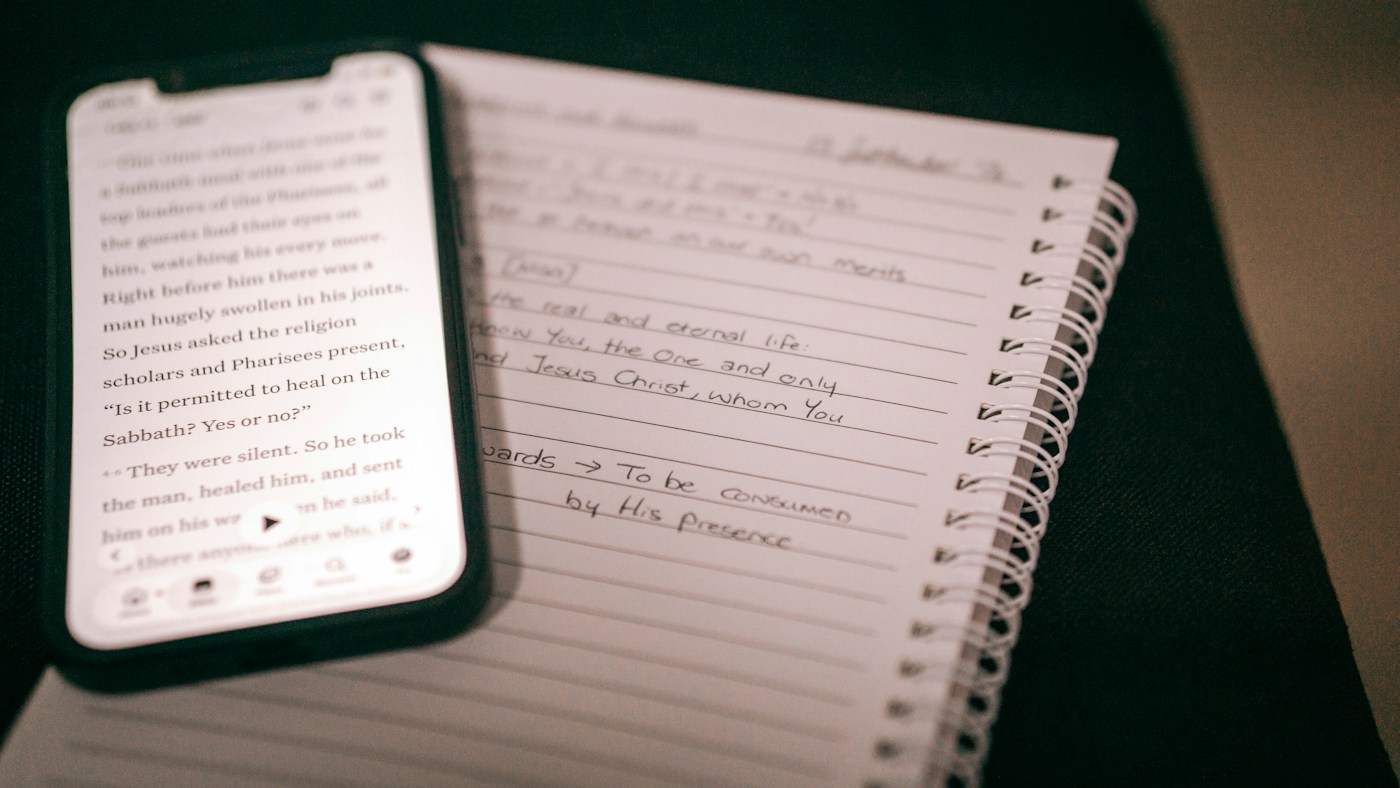
Very few people who use notebooks have given up on screens. The more common pattern is a division of labour. Paper is for thinking and capturing. Screens are for storing, searching, sharing and polishing.
The bridge between the two is usually the phone camera. Many people photograph finished pages and file the photos in a notes app or a shared folder. Some phone and note apps can recognise handwritten text in photos, which makes old pages searchable, though accuracy depends on how neat your writing is.
Jonas, a freelance writer, has a routine for this. At the end of each week he flips through the pages he filled, photographs anything he wants to keep, and types up the few items that need to go into a document or a calendar. “The notebook is where things start,” he says. “If something survives the Friday review, it gets promoted to the computer.”
This weekly review turns out to matter as much as the notebook itself. Notes that are never read again have done some of their work, because writing helps you think. But the review is where loose ideas turn into tasks, and where you catch the promise you made in a meeting and then forgot.
How to start a notebook habit
Buying a notebook is easy. Using it for more than two weeks is harder. Most abandoned notebooks have a few enthusiastic pages at the front and nothing after that. A handful of small habits make a big difference.
Keep it where you work. A notebook in a drawer does not get used. Leave it open on the desk, or carry it in the same bag every day.
Date every page. Writing the date at the top takes two seconds and makes the whole book easier to search by memory later. It also shows you, at a glance, how often you are really using it.
Save the first two pages for an index. When you write something you will want to find again, such as a project plan or a list of book recommendations, add its title and page number to the index.
Allow mess. The notebook is a working tool. Crossings-out, half-finished lists and bad drawings are signs that it is doing its job.
Review it weekly. Set a short, regular time to read back through the week’s pages and move anything important into your calendar, task list or files.
It also helps to decide what the notebook is for. Some people keep one book for everything, from shopping lists to meeting notes. Others keep separate notebooks for work and home. Neither approach is better, but mixing them without thinking about it can make pages hard to find.
When a notebook fills up
Finishing a notebook is quietly satisfying. Many people write the start and end dates on the spine or the cover and put it on a shelf. A row of full notebooks becomes a kind of personal archive: a record of what you were working on, worrying about and planning, in your own handwriting.
Before shelving it, go through the index one last time. Anything you still need, such as a recurring checklist or a list of contacts, can be copied into the next book or photographed. Then start the new one with a clean index and today’s date.
A small tool that stays useful
The people buying dot grid books and good pens are, for the most part, heavy users of screens. They have simply found that one kind of tool is better for storing and sharing information, and another is better for working out what they think.
A notebook asks very little. It needs no updates, no password and no battery. It will not interrupt you, and it will not tidy away your mistakes. For a lot of people, that combination is exactly what their screens cannot offer, and that is why the notebook is still in the bag.

Written by
Ingrid Solberg
Ingrid covers culture and the science of ordinary things. She keeps a paper notebook and will tell you why.
